
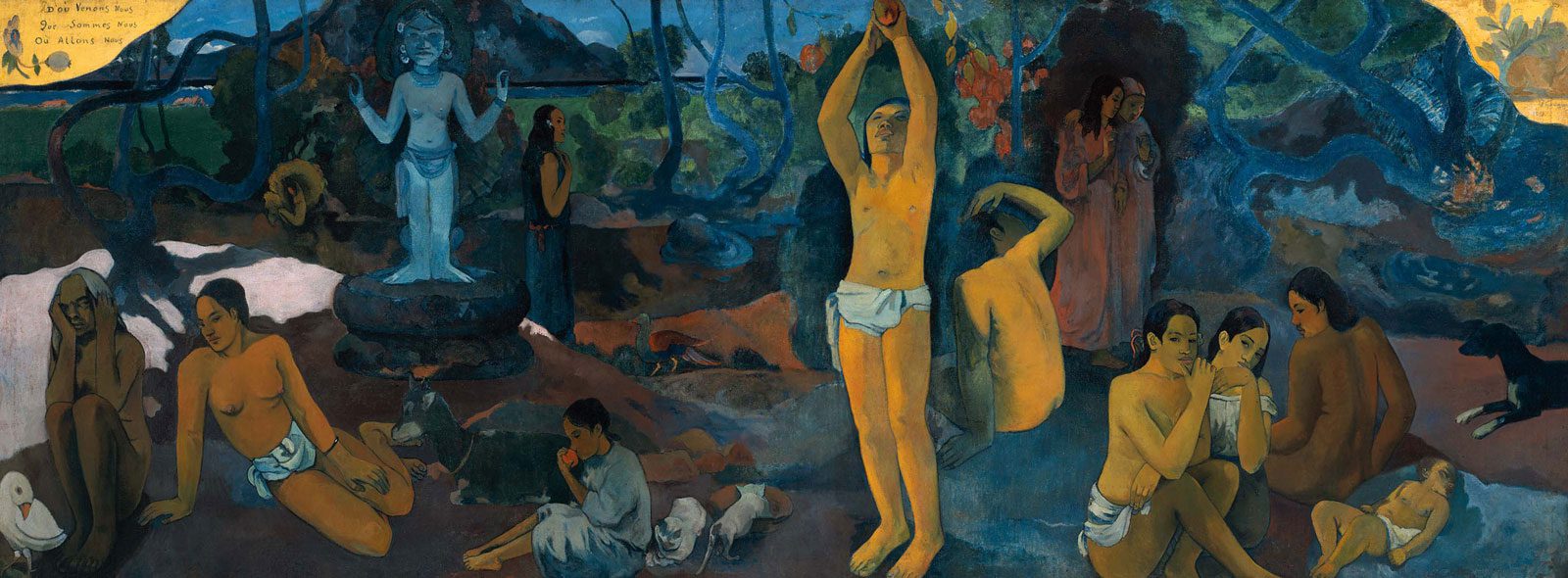
In 1897, the French painter Paul Gauguin, living in Tahiti, completed his most monumental work. He titled it — in three searching questions — Where Do We Come From? What Are We? Where Are We Going? The canvas is enormous, filled with figures in various stages of life and decay. But Gauguin himself had no answers. He was plagued by poor mental health and, shortly after completing the work, attempted suicide.1
He was not asking ‘religious’ questions in any formal sense. He was asking ‘God’ questions — the questions every human being eventually asks, whether or not they use theological language. Genesis 1 is where the Bible’s answer begins.
The Questions That Will Not Go Away
Secular culture has tried to provide answers. In 1903, the philosopher Bertrand Russell argued that humanity’s ‘origin, his growth, his hopes and fears, his loves and his beliefs are but the outcome of accidental collocations of atoms.’ He saw nothing beyond the grave but ‘extinction in the vast death of the solar system.’ Therefore, he concluded, ‘only on the firm foundation of unyielding despair can the soul’s habitation henceforth be safely built.’2
And yet, Russell’s own daughter observed that ‘his whole life was a search for God … In the depths of his soul, there was an empty space that had once been filled by God. And he never found anything else to put in it.’3 The logical conclusion of a world without God is a world without lasting meaning — and human beings seem constitutionally unable to live with that conclusion.
In many cultures that affirm a spiritual reality above the material world, the questions are differently framed but no less urgent. African traditional religion, for example, is generally characterised by a spiritual structure of higher and lesser divinities, mediating ancestors, and holy men who advise on how to appease the ancestors and secure good outcomes.4 African Christians may wonder if Jesus, who is not a member of their community and not approved as an ancestor-mediator, is sufficient to address their spiritual insecurities.
God Confronts Us in Genesis 1
Whether it is a hardened atheist like Russell, an angst-ridden artist like Gauguin, or someone navigating the complex spiritual world of traditional religion, human beings appear irresistibly drawn to spiritual questions that are personal and experiential in nature. And it is God, the Creator of our material and spiritual world, who confronts us in Genesis 1.
Genesis 1 is carefully structured. In verses 1 and 2, the movement is from heaven to earth, from God to the reality he creates from nothing. Verse 2 opens with a bleak image: the earth was ‘without form and void,’ an expression of emptiness and desolation. Without God’s action, the earth had no shape, no substance, and no inhabitants. And then God speaks.
Over six days, God forms what was without form, and fills what was void. He separates light from darkness; sky from sea; sea from land. He fills sky with lights, sea with creatures, land with living things. And after each creative act, ‘God saw that it was good’ — a repeated refrain that accumulates into a declaration: this is a world made by a good God, for good purposes, and it is very good. The staggering truth that Genesis 1 presents is not that the world exists — but that it was made by someone, for us, with purposeful love. Where do we come from? We come from God. What are we? Image-bearers of the living God. Where are we going? Into a relationship with the Creator who made us for himself. These are not abstract answers. They are the foundation on which every human life must be built — and Genesis 1:1-25 presents them with a clarity that no philosopher has surpassed.
- Letters of Paul Gauguin to Georges Daniel De Monfreid, trans. Ruth Pielkovo (Dodd, Mead & Company, 1922), 59-102. ↩︎
- Bertrand Russell, ‘A Free Man’s Worship,’ in Mysticism and Logic and Other Essays (Longmans, Green & Co., 1918), 46-57. ↩︎
- Katharine Tait, My Father, Bertrand Russell (Harcourt Brace Jovanovich, 1975), 189. ↩︎
- Cf. Kwame Bediako, ‘Jesus in African Culture: A Ghanaian perspective,’ in Jesus in Africa: The Christian Gospel in African History and Experience (Regnum Afrika, 2004), 20-33. ↩︎