
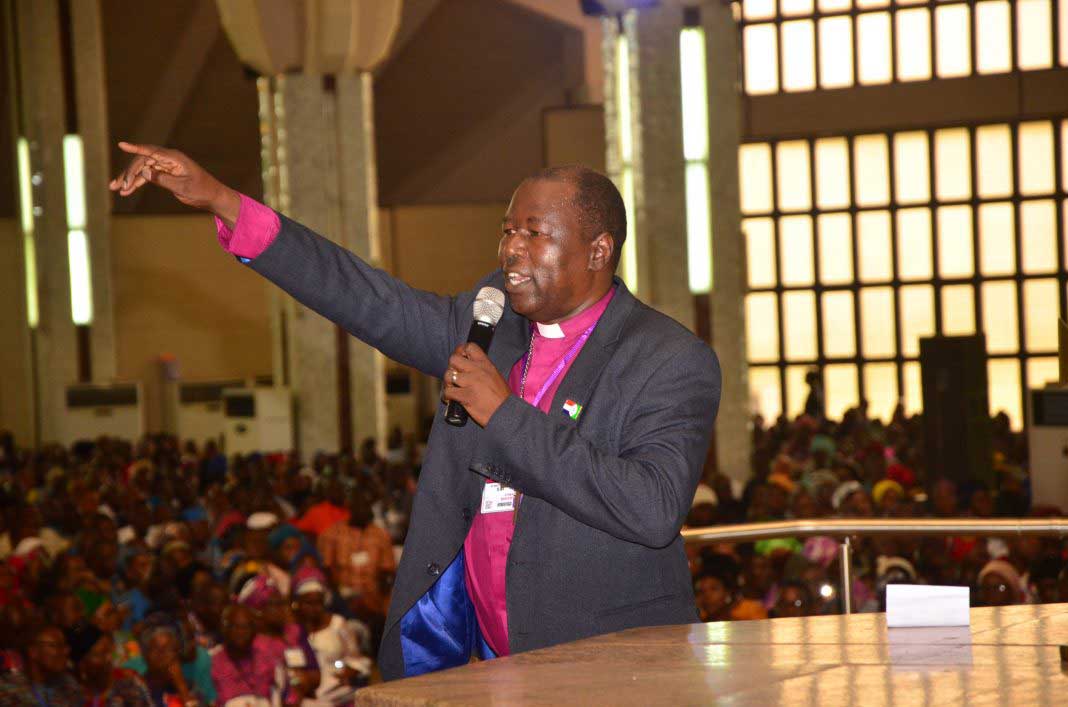
An Address Given at the 3rd Lango Convocation, 27th September 2020, at Coronation Park, Lira City, Uganda, by Rt. Rev. Prof Alfred Olwa, Bishop, Diocese of Lango.
‘And now this admonition is for you, O priests. If you do not listen, and if you do not set your heart to honor my name,” says the LORD Almighty, “I will send a curse upon you, and I will curse your blessings. Yes, I have already cursed them, because you have not set your heart to honor me. Because of you I will rebuke your descendants; I will spread on your faces the offal from your festival sacrifices, and you will be carried off with it. And you will know that I have sent you this admonition so that my covenant with Levi may continue,” says the LORD Almighty. “My covenant was with him, a covenant of life and peace, and I gave them to him; this called for reverence and he revered me and stood in awe of my name. True instruction was in his mouth and nothing false was found on his lips. He walked with me in peace and uprightness, and turned many from sin. For the lips of a priest ought to preserve knowledge, and from his mouth men should seek instruction—because he is the messenger of the LORD Almighty. But you have turned from the way and by your teaching have caused many to stumble; you have violated the covenant with Levi,” says the LORD Almighty. “So I have caused you to be despised and humiliated before all the people, because you have not followed my ways but have shown partiality in matters of the law.’ (NIV)
In our text Malachi addresses the priests directly: ‘And now, O priests, this command is for you’ (Mal 2:1). Before we turn to the text itself, we should ask what relevance it has for us.
Who Are Priests today? Or Are There Any?
The New Testament never uses the word priest to describe a pastor or elder in the church. There is no official priesthood in the New Testament church.
The reason is clear: Jesus Christ has become our permanent priest, and the Old Testament priesthood is now obsolete (cf. Heb 8:13). The writer to the Hebrews explains why:
‘The former priests were many in number, because they were prevented by death from continuing in office, but he holds his priesthood permanently, because he continues forever. Consequently, he is able to save to the uttermost those who draw near to God through him, since he always lives to make intercession for them’ (Heb 7:23-25).
Christ is now the one and only priest who stands between us and God, because his sacrifice was final (Heb 7:27) and his life is indestructible (Heb 7:16). His offering needs no repetition: ‘When Christ appeared as a high priest . . . he entered once for all into the holy places, not by means of the blood of goats and calves but by means of his own blood, thus securing an eternal redemption’ (Heb 9:11–12)
The Old Testament priesthood has therefore been replaced, once and for all, by the priestly ministry of Jesus: the once and for all offering of himself as the final sacrifice for sin, and his continuing intercession for us in heaven.
The Whole Church as a Holy Priesthood
Instead, Peter calls the whole church a ‘holy priesthood’ (1 Pet 2:5) and a ‘royal priesthood’ (1 Pet 2:9), and Revelation (1:6) declares that Christ has made his people ‘a kingdom, priests to his God and Father.’
Christ has opened the way for all of us to come directly to God through him. We need no other mediator (1 Tim 2:5). With Christ, our great high priest, we can walk right into the Most Holy Place where God dwells (Heb 10:19-22), and ‘find grace to help in time of need’ (Heb 4:16).
There is, then, no separate order of priests in the New Testament church. Its leaders share in the priesthood of all believers as members of the body, not because of the office they hold.
The Priest as Teacher
This raises a further question: did the priests of the Old Testament have duties besides offering sacrifice on behalf of the people—duties that continue in the New Testament?
The answer is a clear yes. Malachi describes the priest as the guardian and teacher of God’s truth: ‘For the lips of a priest should guard knowledge, and people should seek instruction from his mouth, for he is the messenger of the LORD of hosts’ (Mal 2:7).
The priests, in other words, were teachers, and this part of their ministry continues in the church of the New Testament. Paul admonishes all Christians to teach each other:
‘Let the peace of Christ rule in your hearts, since as members of one body you were called to peace. And be thankful. Let the message of Christ dwell among you richly as you teach and admonish one another with all wisdom through psalms, hymns, and songs from the Spirit, singing to God with gratitude in your hearts.’ (Col 3:15-16)
But more than that, which highlights how foundational teaching is to the health of the church, Christ gave to the church pastors and teachers to equip the saints for the work of ministry (Eph 4:11–12). Overseers must be able to teach (1 Tim 3:2), and some elders are to labour in preaching and teaching (1 Tim 5:17; cf. Titus 1:9).
This priestly duty, then, is especially carried forward in the elders of the New Testament church, who are responsible to teach and guide God’s people. Yet they are never called priests, for that would suggest too close a likeness to the Old Testament office. In the New Testament the language of priesthood is reserved for Christ himself and applied to believers as a whole (1 Pet 2:5, 9; Rev 1:6); it is never used of a distinct ministerial order.
Pastors do not offer sacrifices for the forgiveness of sins, whether in the Mass or in any other way. We do not offer Christ to the Father upon an altar. By the Word of God we point people to the finished, all-sufficient work of the cross, and directly to the living Christ who intercedes for them. When we pray, we are joining in his prayers for us.
We are, above all, teachers and preachers of God’s Word. This is why Malachi 2:1–9 speaks so directly to us today: the failure Malachi exposes lies above all in the priests’ duties as teachers and as examples to the people (Mal. 2:6–9). Their failure would be no less a failure in us.
Why This Matters for the Whole Church
A further question now arises: why should church members who are not pastors take an interest in a study of the failures and faithfulness of the pastoral calling? There are at least four reasons.
- Your church will one day need a new pastor. Your present pastor will not serve you for ever, and the congregation will have to call another. Many churches are unprepared to do this well, because they have never been taught the biblical vision of pastoral ministry.
- You are called to pray for your pastors. You should pray daily for those who lead the church. But you cannot pray with confidence and understanding unless you know what Scripture teaches about both the purposes and the pitfalls of pastoral ministry.
- You share in holding your pastors accountable. This is not at odds with the submissive spirit that Hebrews 13:17 commands. Christ has given the church as a whole a real part in matters of order and discipline (Matt. 18:17; 1 Cor. 5:4). But you cannot hold your leaders to their duty if you do not know what that duty is.
- An understanding congregation encourages its pastor. Nothing heartens a pastor more than a people who understand why he does what he does and who share his vision for his ministry. That kind of glad responsiveness grows only where the people have learned the biblical vision of the pastoral calling.
We have now laid a foundation for our study. This text about Old Testament priests matters for pastors today, and even those who are not pastors should care about what it teaches.
When God foretold the ruin of his people Israel through the prophet Amos, he warned of a famine more terrible than any lack of bread:
‘Behold, the days are coming, declares the Lord GOD, when I will send a famine on the land—not a famine of bread, nor a thirst for water, but of hearing the words of the LORD. They shall wander from sea to sea, and from north to east; they shall run to and fro, to seek the word of the LORD, but they shall not find it’ (Amos 8:11–12)
Such a famine is the bitterest fruit of priestly failure, and it is this failure that concerns Malachi most (Mal 2:7–8). So let us turn to the text and see how he confronts it.
Failure Contrasted with Faithfulness
In Malachi 2:1–9 the prophet sets the failure of the priests in his own day against the faithfulness of Levi, with whom God first made his covenant of priesthood (Mal 2:4–7). Verses 5–7 portray a faithful priesthood, and verses 2, 8 and 9 name several failures. Our focus here will be the two deepest of these failures, both found in verse 2.
These two failures are named in the Lord’s charge to the priests:
‘And now, O priests, this command is for you. If you will not listen, if you will not take it to heart to give honour to my name, says the LORD of hosts, then I will send the curse upon you and I will curse your blessings. Indeed, I have already cursed them, because you do not lay it to heart’ (Mal 2:1–2).
Two Deep Priestly Failures
Two priestly failures stand out in verse 2: the failure to listen to God, and the failure to take his honour to heart.
1. The Failure to Listen to God
‘If you will not listen . . . then I will send the curse upon you’ (Mal. 2:2).
One great danger in pastoral ministry is that the voice of God in Scripture may be drowned out by other voices. Few things in ministry are more frightening than the thought that we might one day open the sacred page and hear nothing from God.
Why is this so terrible? Because, as verse 7 reminds us, the priest is ‘the messenger of the LORD of hosts’, and so is every minister of the Word.
A lecture on the meaning of ancient texts is not the same as a message from the Lord of hosts. God has not appointed preachers in the church simply to lead discussions, solve problems or analyse texts. He has appointed them to herald a message to his people. And we cannot herald what we have not heard.
Years ago in Boroboro, a vicar climbed into the pulpit at Christmas carrying a large commentary. He spent the sermon quoting what various scholars had said about the Christmas story. Afterwards one of the Balokole, the ‘saved ones’ of the East African Revival, came to him and said: ‘Vicar, we know what the others have said, because you quoted them. What we want to know from you is this: does God have anything to say?’
‘If you will not listen . . . says the LORD of hosts, then I will send the curse upon you.’
2. The Failure to Take God’s Honour to Heart
The second failure in verse 2 is the failure to carry a heart burden for the glory of God: ‘If you will not take it to heart to give honour to my name, says the LORD of hosts, then I will send the curse upon you.’
Note the wording carefully. The Hebrew speaks of setting something upon the heart (śîm ʿal-lēb), and the word rendered ‘honour’ (kābôd) is the Bible’s great word for glory. The issue is not merely whether the glory of God is the unifying theme of a minister’s doctrine and preaching. It is whether a burden to see God glorified lies upon his heart.
So a congregation must ask: is the glory of God not only part of the pastor’s theology but the passion of his soul? Does it come before the approval and praise of his people, before professional advancement, before financial reward and material comfort? Does he return to it again and again, as a compass needle swings back to the north, or a weather vane turns in a heavenward wind? Does it show in private as well as in public, in praying as well as preaching, in play as well as in study?
What could matter more in calling a pastor, praying for a pastor or holding a pastor accountable than this: that the glory of God’s name weighs upon his heart?
So long for that kind of pastor. Love the Word of God and the glory of his name, and pray for such a pastor until God gives him to you—to the glory of our great God and Saviour.
Learning from Those Who Went Before
Our calling requires theological training. Pastors who are theologically educated learn from the faithfulness of those who went before them, and from their failures too.
It is arrogance for a pastor to think of himself as the first in pastoral ministry, or to imagine that his insight and gifts surpass everything that has gone before. Pastoral ministry has a long history, and there is much to learn from how the church has understood it and practised it.
That history also shows that pastoral practice has varied with time, place and church tradition. Exposure to these varied understandings helps pastors to identify what is essential to pastoral ministry, to embrace it, and to apply it faithfully in their own contexts. Pastors benefit greatly from the example of faithful ministry in the past, and they must also learn from its mistakes so as not to repeat them.
The Case for Theological Training
This is especially relevant to the current debate over whether pastors need theological education at all. From the apostolic church onwards, the church’s history teaches that a call from God is no reason to reject or despise training.
Paul was called by the risen Christ himself and commissioned to take the gospel to the Gentiles. Yet he was thoroughly trained in the Scriptures of the Old Testament, having been educated at the feet of Gamaliel (Acts 22:3; cf. Phil. 3:5–6). He also laid his gospel before the leaders of the church in Jerusalem, ‘in order to make sure I was not running or had not run in vain’ (Gal. 2:2), and they recognised the grace given to him (Gal. 2:9).
In the early church, too, pastoral ministry was not entrusted to the untrained, even when they were called by God. Paul trained Timothy and charged him to train others in turn (2 Tim. 2:2). An overseer had to be ‘able to teach’ (1 Tim. 3:2), and he could not be a recent convert (1 Tim. 3:6), because the knowledge required came through observation and instruction, and both take time.
Throughout its history, the church has generally taken the same care. Its bishops have sought to ensure that those who shepherd God’s people receive due training before they are ordained. That care has weakened mainly in recent times, where religion has been deregulated and left to the forces of the market.